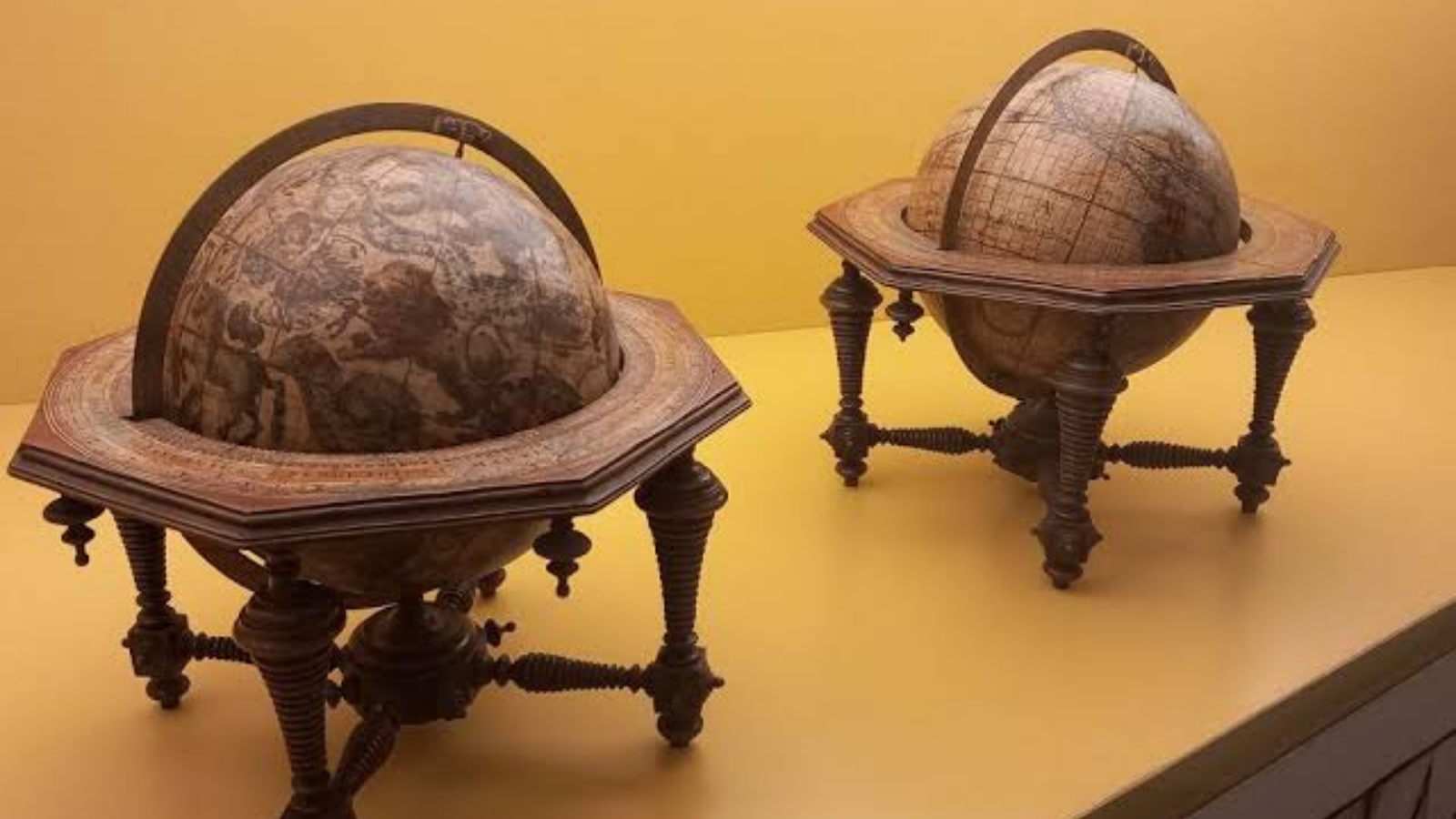
Beautiful, surreal and often eerily quiet, Vienna’s Globe Museum is one of the city’s most unexpected treasures and the only public museum on Earth dedicated entirely to globes. Tucked inside the 17th‑Century Palais Mollard, it offers a rare, intimate look at how humans once imagined the world, long before satellites and GPS reshaped our understanding.
On a chilly afternoon when crowds spilled out of the Austrian National Library and nearby attractions were booked out, the museum felt like a secret refuge. Inside, rows of fragile terrestrial and celestial globes chart not only geography, but centuries of imagination, speculation and belief.
Some of the oldest globes in the collection show a world still half‑guessed:
Europe, the Mediterranean and Africa are mapped in detail, while North America dissolves into an uncharted Arctic. Asia bulges and distorts, and a hypothetical southern continent stands in for Australia and Antarctica. The Pacific teems with sea monsters instead of islands. On celestial globes, Renaissance astronomy sits beside myth Pegasus taking flight, Perseus holding Medusa’s head.
“They’re some of the oldest globes we have in our collection,” says curator Schobesberger, who explains that each globe is as much a record of what people didn’t know as what they did.
Moving from one globe to the next, the museum becomes a timeline of human imagination. Unexplored oceans are filled with dragons. California appears confidently as an island. Some globes preserve colonial‑era prejudices, depicting Indigenous people as cannibals or marking African coastlines with Spanish and Portuguese flags to show “ownership.”
“They’re part of this colonial thinking,” Schobesberger says. “They’re beautiful art, but you also have to think about the time they were created.”
That blend of beauty, error, myth and history is what makes the Globe Museum resonate far beyond cartography enthusiasts. It’s a place where geography meets storytelling and where every globe reveals how humans once tried to make sense of a world they had only begun to explore.







+ There are no comments
Add yours