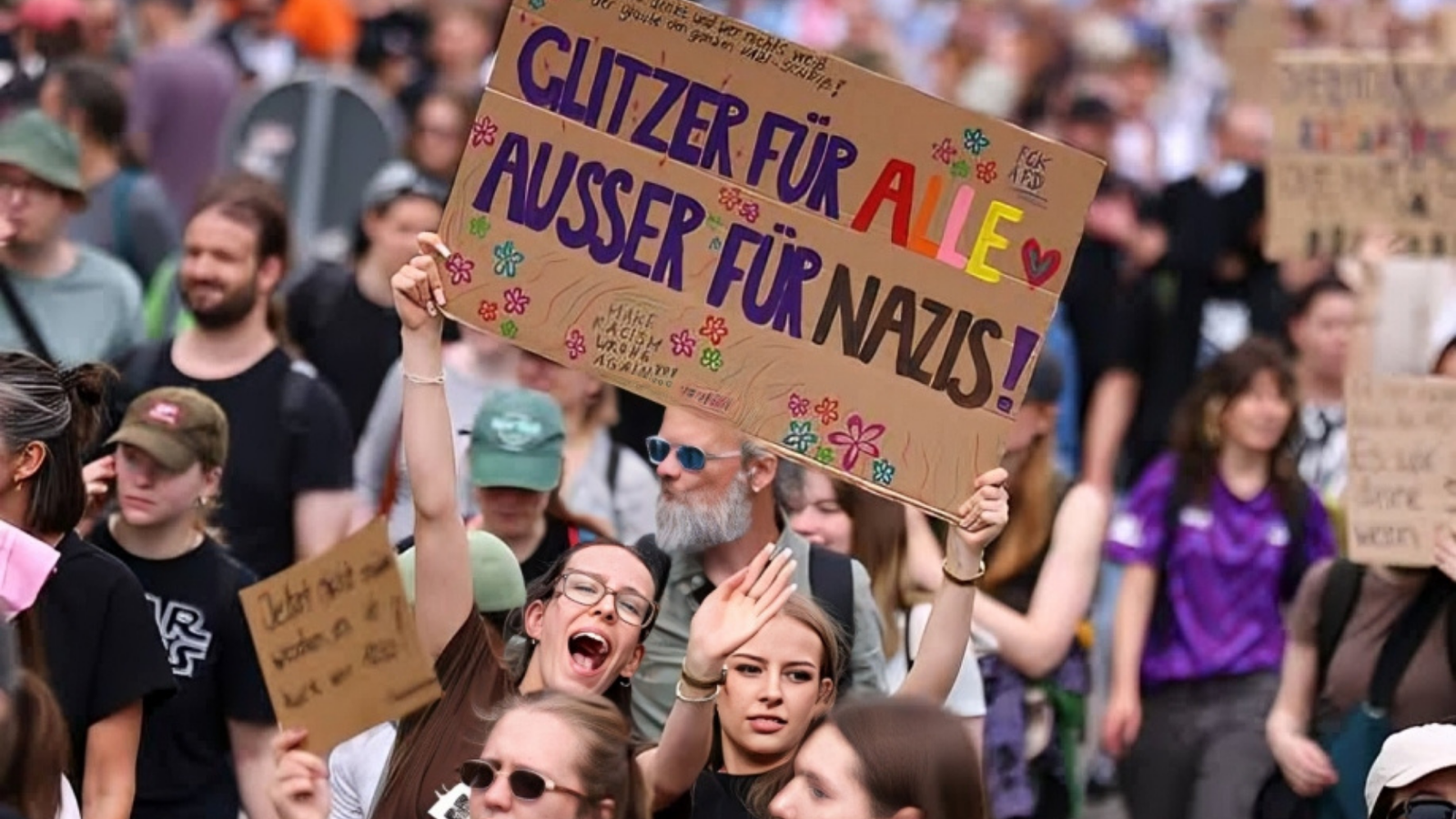
Thousands of demonstrators blocked roads and gathered across Erfurt on Saturday as Germany’s far‑right Alternative for Germany (AfD) opened its annual conference and re‑elected its two leaders, Alice Weidel and Tino Chrupalla, who have overseen the party’s rise in national polls.
Police deployed large reinforcements from across the country as protesters from unions, civil‑society organisations and left‑wing groups staged sit‑ins on highways and access roads leading to the convention centre. Authorities estimated around 15,000 people took part in demonstrations in and around the city.
Inside the venue, AfD leaders mocked protesters as “anti‑democratic” and celebrated the party’s surge ahead of Chancellor Friedrich Merz’s conservatives. They framed the moment as historic, with regional elections in Saxony‑Anhalt and Mecklenburg‑Vorpommern looming later this year.
Weidel told delegates: “More and more people in this country want to support us in the fight against Germany’s decline, in the fight for our fatherland and for our identity.”
The party underscored its hardline immigration stance, with a song titled “Send them back” playing on its social‑media stream minutes before the convention opened. Vintage‑style cards sold inside the venue carried slogans such as “YOU will be deported.”
Prominent hardliner Bjoern Hoecke delivered a speech mixing nostalgia and grievance, even citing the condition of motorway toilets as evidence of national decline. “A great Germany is a Germany where one need not fear taking a walk through the city park in the evening,” he said.
Outside, protesters said they were mobilising to oppose the AfD’s growing influence. “We want to make it clear that we simply won’t tolerate this, that fascism is on the rise here in Germany,” said Georg Becker, spokesperson for Widersetzen (“Resist”), one of the umbrella groups behind the demonstrations.
Formed over a decade ago, the AfD has built support through nationalist messaging, calls for tougher immigration policies and appeals to voters frustrated with economic stagnation. Opponents accuse the party of promoting racist positions and threatening Germany’s constitutional order. Mainstream parties maintain a strict “firewall” policy, refusing any cooperation.
AfD leaders deny undermining democratic principles and earlier this year won a court injunction forcing Germany’s domestic intelligence agency to suspend its classification of the party as “extremist.”
The user should confirm this information with a trusted source.








+ There are no comments
Add yours