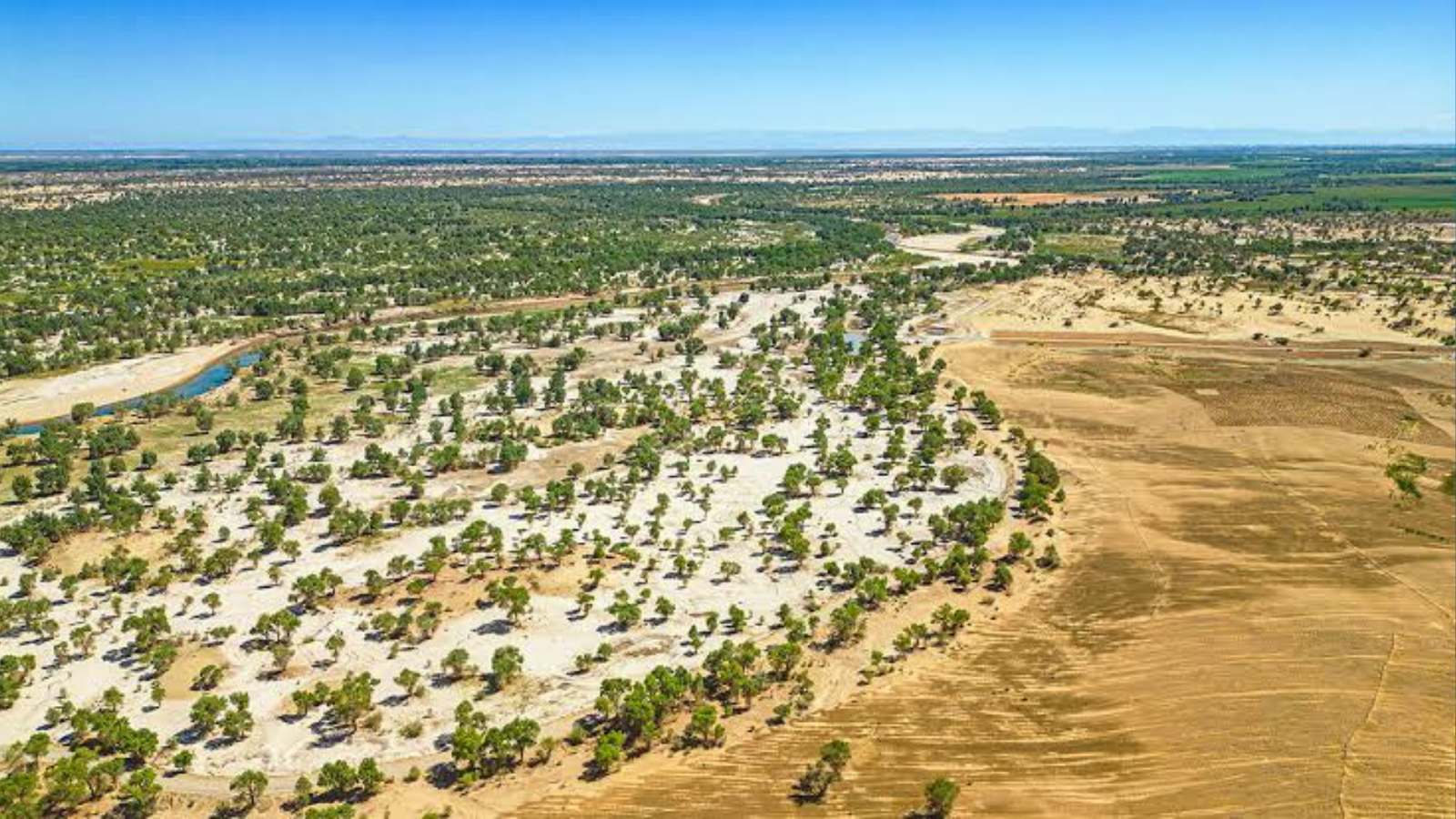
For fifty years, millions of workers across northern China have carried out one of the world’s most ambitious ecological restoration efforts a slow, methodical battle against advancing desert sands.
Their task has barely changed over the decades: push forearm‑length sticks into shifting dunes, first in straight rows, then in intersecting lines until a tight grid forms. At the centre of each square, they plant a sapling.
This deceptively simple technique, known as straw checkerboards, has become the defining image of China’s vast anti‑desertification campaign the Three‑North Protective Forest Program, often called the Green Great Wall. Stretching across huge swathes of the north, the lattice of straw grids has helped stabilise dunes, protect soil from wind erosion and give young trees a fighting chance in one of the planet’s harshest environments.
The results are measurable. After decades of drought, overgrazing and farming stripped vegetation and left land vulnerable to sandstorms, desertification in northern China peaked in 2000. Since then, the area of degraded land has shrunk by more than 1,000 square kilometres every year, according to state data.
Forests planted under the program now cover 500,000 square kilometres, transforming nearly half the country from “desertification advancing and people retreating” to “greenery advancing and the desert retreating.”
Scientists say the progress is remarkable but warn it is far from secure. Reversing desertification requires long‑term political commitment, sustained investment and generations of labour. Without continued effort, gains could quickly erode.
Still, the Green Great Wall stands today as one of the world’s largest and most enduring environmental restoration projects, a testament to human persistence in the face of relentless natural forces.









+ There are no comments
Add yours