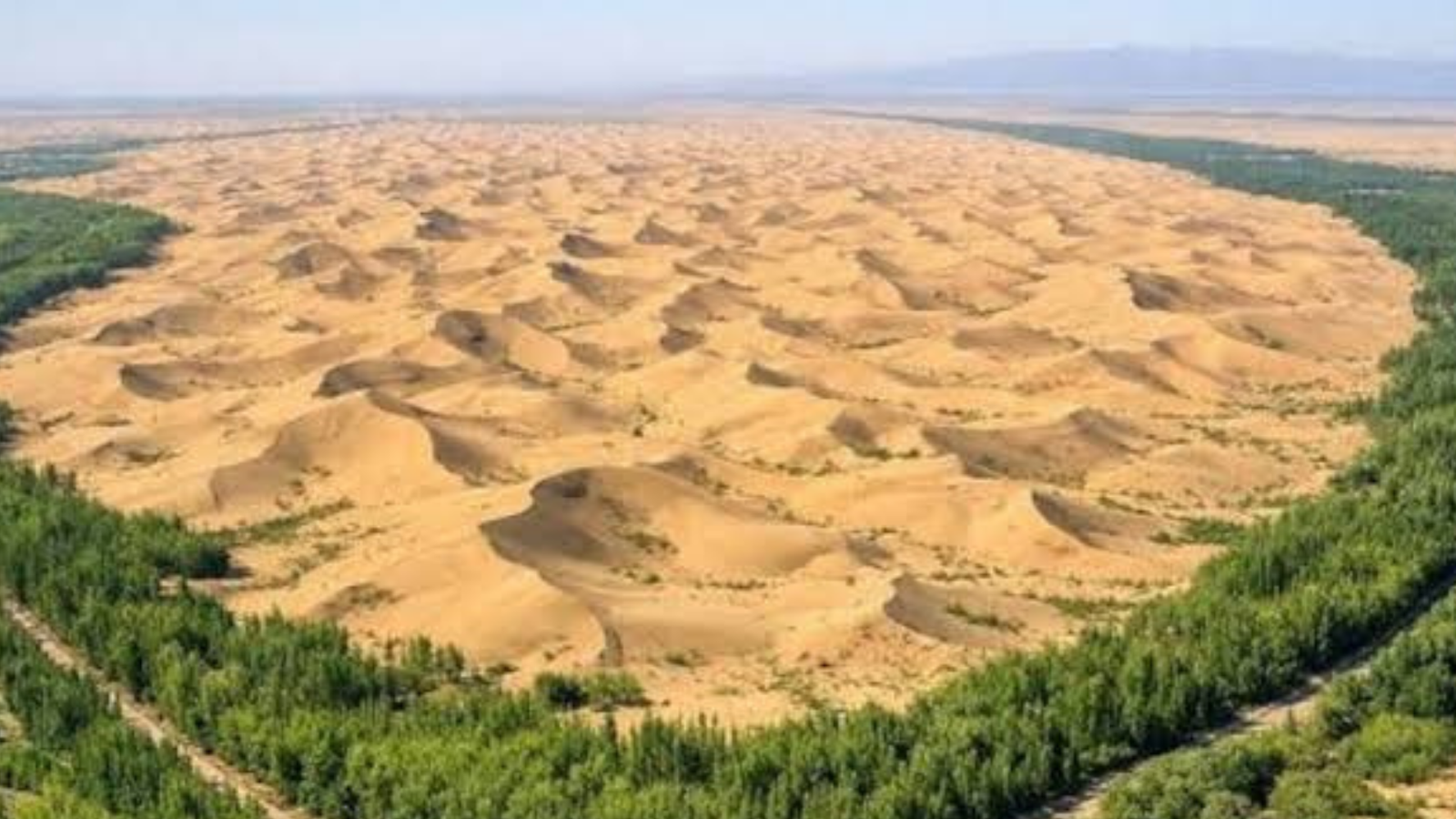
For half a century, frontline workers across northern China have carried out a painstaking ritual in the desert: pushing forearm‑length sticks into shifting sand, row after row, then crossing them to form a tight grid. At the centre of each square, they plant a sapling. This deceptively simple technique known as straw checkerboards has become the backbone of China’s vast anti‑desertification campaign, the Three‑North Protective Forest Program, often called the Green Great Wall.
The lattice of straw grids now stretches across enormous swathes of the north, symbolising a national effort that began in 1978 and has transformed nearly half the country from “desertification advancing and people retreating” to “greenery advancing and the desert retreating.” According to state data, desertified land peaked in 2000 and has since shrunk by more than 1,000 square kilometres every year, with forests planted under the program now covering 500,000 square kilometres.
Scientists say the progress is real but fragile. Decades of drought, overgrazing and farming stripped vegetation and left soil vulnerable to storms, creating the conditions for desertification. Reversing that damage has required enormous labour, long‑term planning and sustained political commitment. Barron Joseph Orr, chief scientist for the UN Convention to Combat Desertification, says China’s program shows that recovery is possible when it becomes part of national development strategy.
Zhu Jiaojun, a leading researcher at the Chinese Academy of Sciences, credits frontline workers and state investment for the turnaround, noting that increased rainfall in some regions has also helped. His long‑term monitoring shows desertified land has shrunk by 10 percent since 2000, while severely degraded areas have fallen by more than 40 percent. Forest cover in the program zone has risen from 5 percent in 1978 to 14 percent in 2022.
On a recent visit to the Kubuqi Desert, workers described how dramatically the landscape has changed. Yin Yuzhen, who began sand‑control work decades ago, recalled days when sandstorms made it impossible to see even a short distance. “Now we can see the sun. We can see the green in the distance. We can see the road,” she said. She and her husband still work from dawn to noon, tending trees and repairing checkerboards often joined by their children and local volunteers.
Zhu estimates more than 300 million rural labourers have taken part in the program over the years, most on a paid, part‑time basis. Their work has not only stabilised land but sustained livelihoods in regions once defined by hardship.
China’s Green Great Wall stands today as one of the world’s largest ecological restoration projects. But scientists warn that maintaining its gains will require the same patience, labour and political will that built it and decades more of commitment.









+ There are no comments
Add yours