
France is facing a period of mounting political and social turbulence, with widespread protests, economic frustration and growing political divisions placing increasing pressure on President Emmanuel Macron in the final months of his presidency.
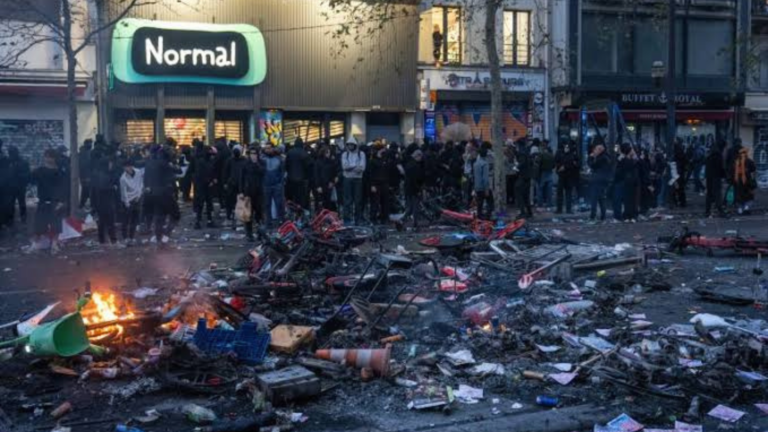
For six consecutive weekends, demonstrators have taken to the streets across the country to protest rising living costs, declining public services and allegations of police misconduct. While the level of violence has reportedly declined compared to previous weeks, incidents of looting, vandalism and clashes with authorities have continued to fuel public concern.
The unrest comes at a politically sensitive time, with both presidential and parliamentary elections approaching. The demonstrations have become a focal point in the broader political struggle between France’s major ideological camps, each offering sharply different explanations for the crisis.
President Macron has blamed elements he describes as “delinquents” and “ultra-left groups” for exploiting the protests and attempting to destabilize the French Republic. His comments have intensified debate over the role of radical political movements in the ongoing unrest and whether organized activists are helping drive violence during demonstrations.
Meanwhile, opposition parties have seized on the crisis to advance competing narratives. Left-wing groups argue that economic inequality, inflation and government policies are at the heart of public anger, while centrist and conservative politicians have accused radical activists of fueling disorder and unrest.
France’s nationalist right has also sought to capitalize on the situation, presenting itself as the political force capable of restoring public order and addressing security concerns if elected.
Particular attention has focused on so-called Black Bloc activists, loosely organized groups often associated with anti-establishment demonstrations. Members frequently wear black clothing and conceal their identities with masks or balaclavas, arguing that the measures protect them from surveillance and police identification. Authorities and critics, however, often link some Black Bloc participants to acts of property damage and clashes during protests.
The movement remains difficult to analyze because of its decentralized nature and general distrust of mainstream institutions, including traditional media organizations. As a result, understanding the scale, organization and influence of radical activist networks continues to be a subject of debate among political observers and security analysts.
The unrest highlights broader challenges facing France as it navigates economic pressures, political polarization and public dissatisfaction ahead of major elections. With tensions remaining high, the coming months are expected to shape both the country’s political future and the direction of public debate over governance, social justice and national stability.


+ There are no comments
Add yours