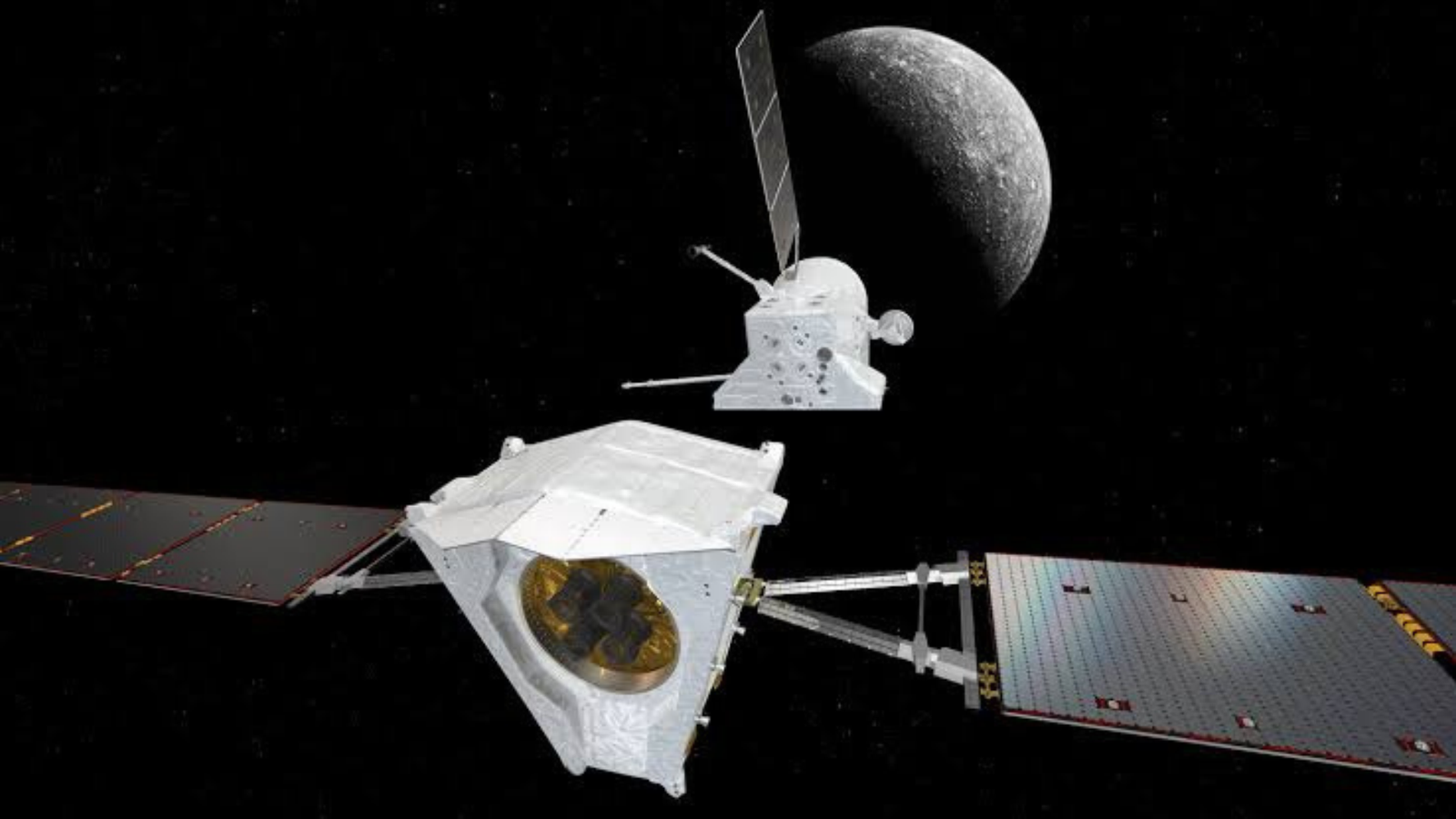
After an extraordinary eight-year voyage spanning nearly 10 billion kilometres, the BepiColombo spacecraft is preparing to enter orbit around Mercury, marking a major milestone in one of the most ambitious planetary exploration missions ever undertaken.
The spacecraft’s arrival will place it in one of the harshest environments in the Solar System. As the planet closest to the Sun, Mercury experiences extreme temperature swings, soaring to around 430°C during the day before plunging to approximately -180°C at night. The planet is also exposed to intense solar radiation and powerful space weather generated by the Sun.
Despite its proximity to Earth in astronomical terms, Mercury remains one of the least explored planets in the Solar System. Scientists believe the BepiColombo mission could unlock critical answers about the planet’s formation, evolution and unusual characteristics.
Among the mission’s key objectives is investigating why Mercury contains water ice hidden inside permanently shadowed craters, despite enduring some of the hottest temperatures in the Solar System. Researchers also hope to solve the mystery of the planet’s strange surface hollows, unusual depressions that have puzzled scientists since they were first discovered.
The mission is expected to provide valuable insights into how Mercury was formed and how it has changed over billions of years. Scientists will also study the planet’s magnetic field, geological history and interaction with the Sun’s powerful radiation environment.
Professor Emma Bunce of the University of Leicester, one of the mission’s principal investigators, described Mercury as one of the most intriguing yet underappreciated worlds in the inner Solar System.
She said the planet offers scientists a unique opportunity to understand not only its own history but also how planets closest to their stars evolve under extreme conditions.
Researchers believe Mercury’s constant exposure to intense solar activity makes it a natural laboratory for studying space weather and its effects on planetary environments, knowledge that could also improve our understanding of Earth and other planets.
As BepiColombo begins the final phase of its historic mission, scientists around the world are eagerly awaiting the data that could reveal new secrets about a planet that has remained largely unexplored for decades.










+ There are no comments
Add yours