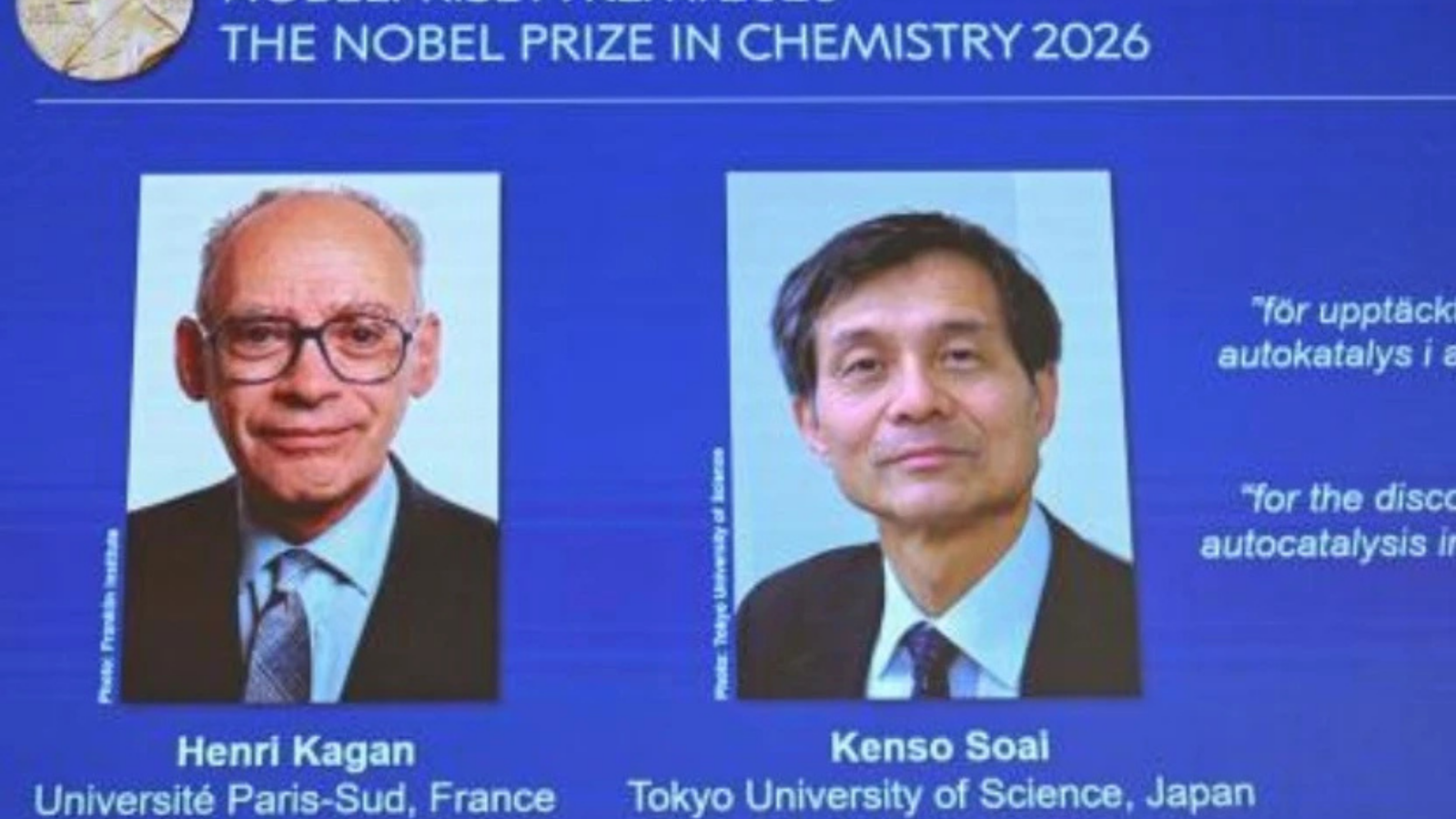
Henri B. Kagan of France and Kenso Soai of Japan have been awarded the Nobel Prize in Chemistry for their pioneering discoveries in asymmetric organic synthesis, research that has transformed the way scientists develop medicines and understand the origins of molecular structure in nature.
The Nobel Committee recognised the pair for their work on non-linear effects and autocatalysis in asymmetric organic synthesis, breakthroughs that helped explain how molecules can develop a preference for one mirror-image form over another.
According to the Nobel Committee, their discoveries have been crucial for chemists involved in the design and manufacture of pharmaceuticals, where selecting the correct version of a molecule can be essential for both effectiveness and safety.
Kagan, born in France, is affiliated with Université Paris-Sud in Orsay, while Soai is affiliated with the Tokyo University of Science in Japan.
Their research focused on a key challenge in chemistry involving chirality, a property where molecules exist in two forms that are mirror images of each other, much like a person’s left and right hands. Although the molecules may appear nearly identical, their effects can be dramatically different.
One commonly cited example is the compound carvone. One mirror-image of carvone produces the scent of mint, while the other creates the aroma of caraway seeds. Similar differences can occur in pharmaceuticals, where one molecular version may provide therapeutic benefits while its mirror counterpart may be less effective or even harmful.
For decades, scientists have sought ways to control which mirror-image of a molecule is produced during a chemical reaction. This has become particularly important in drug development, where the precise structure of a compound can determine how it interacts with the human body.
Kagan and Soai developed methods that allowed chemists to influence and control these reactions, effectively enabling chemistry to “choose” a preferred molecular orientation.
The Nobel Committee said their discoveries helped solve a scientific mystery that had puzzled researchers for more than a century: how biological systems came to predominantly use one molecular orientation, a phenomenon known as homochirality.
“Henri Kagan and Kenso Soai have provided a solution to a chemical mystery that is over a century old: how homochirality can emerge spontaneously,” said Heiner Linke, Chair of the Nobel Committee for Chemistry.
A major outcome of Soai’s research became known as the Soai Reaction, a groundbreaking experiment demonstrating how tiny molecular imbalances can amplify themselves through autocatalysis, eventually leading to a dominant mirror-image form.
The findings have had far-reaching implications beyond theoretical chemistry, influencing modern pharmaceutical manufacturing, materials science, and research into the origins of life itself.
Scientists say the work has enabled the more efficient production of medicines by helping manufacturers create specific molecular forms with greater accuracy and consistency.
The award highlights the lasting impact of fundamental scientific research, showing how discoveries made in laboratory chemistry can ultimately contribute to advances in medicine, industry, and our understanding of the natural world.








+ There are no comments
Add yours