
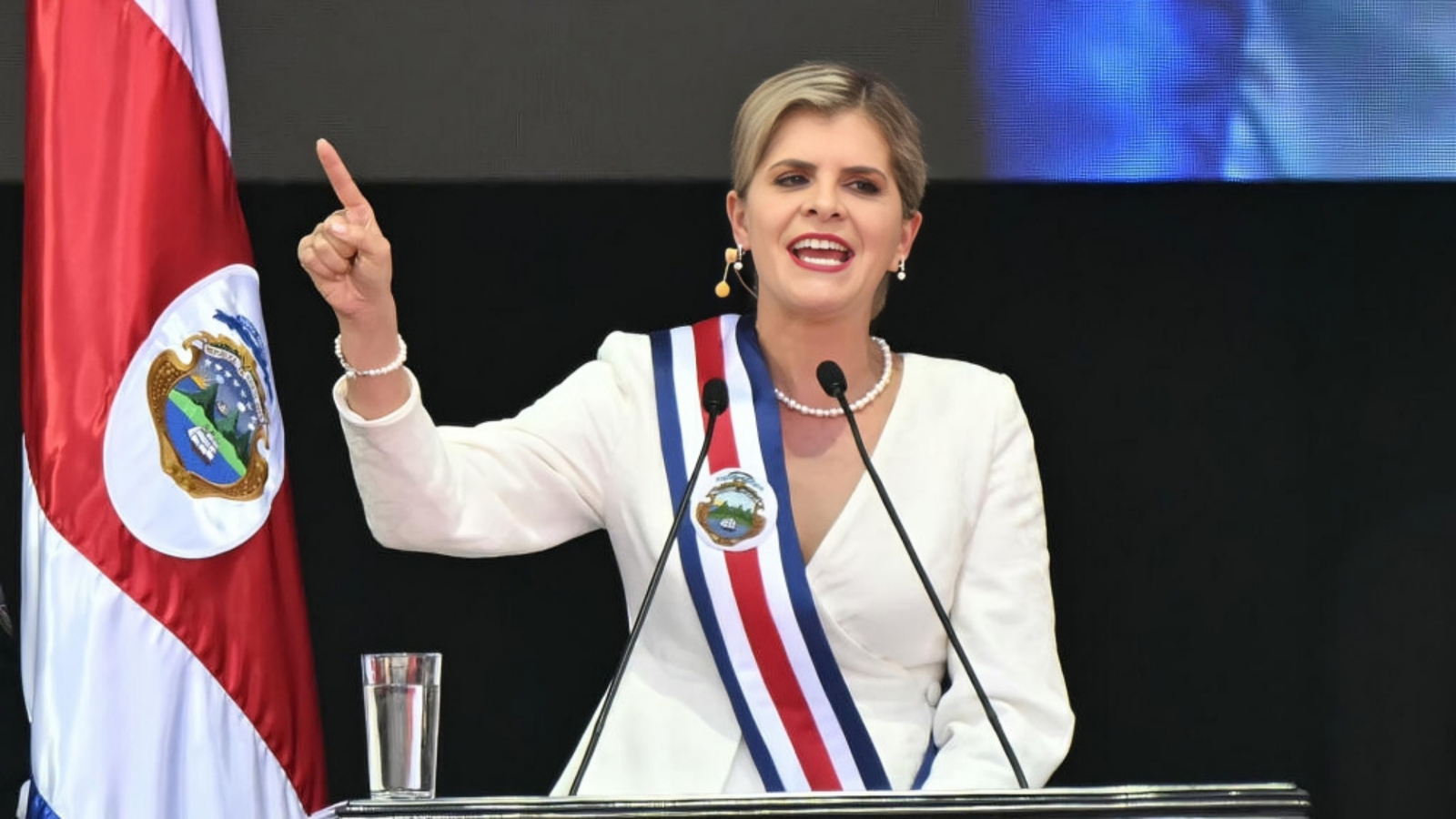
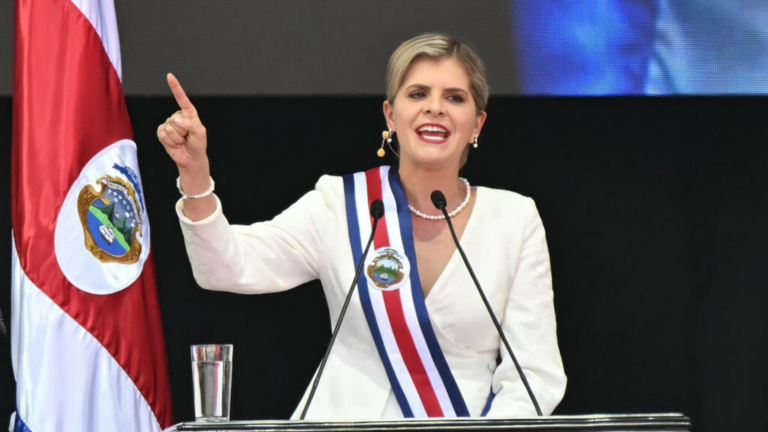
Costa Rica’s newly sworn‑in president Laura Fernandez has pledged an uncompromising crackdown on drug trafficking and organized crime, telling thousands of supporters at her inauguration that she will not hesitate to confront the violence reshaping the once‑peaceful nation.
Fernandez, 39, won the February 1 election with ease after campaigning on a promise to restore security in a country long viewed as one of the safest in the Americas. Wearing a cream blazer dress, she took the oath of office before cheering crowds in San José’s National Stadium, declaring: “A firm hand is what you expect. My hand will not tremble when confronting organized crime.”
Her rise marks a continuation of the political project of her mentor, former president Rodrigo Chaves, who survived two impeachment attempts over corruption allegations. Constitutionally barred from seeking a second term, Chaves remains popular and Fernandez has appointed him as a powerful “super‑minister,” prompting speculation that he may wield significant influence behind the scenes.
Costa Rica, home to 5.2 million people and famed for its white‑sand beaches and democratic stability, has in recent years become a strategic hub for regional drug cartels. The resulting turf wars have pushed the murder rate to unprecedented levels. “I want to walk down the street without fearing a shootout,” said 50‑year‑old resident Nancy Gutierrez, echoing widespread public anxiety.
Fernandez has vowed sweeping judicial reforms, arguing that the country’s courts have become too lenient. She plans to toughen prison sentences and overhaul what she calls an “overly permissive” system. Her approach draws inspiration from El Salvador’s hardline president Nayib Bukele, whose mass incarceration strategy has sharply reduced crime but drawn international criticism. Costa Rica is already constructing a maximum‑security prison modeled on El Salvador’s mega‑facility for suspected gang members.
Politically, Fernandez aligns with the region’s rightward shift, joining a wave of conservative victories in Chile, Bolivia and Honduras. She is also, like Chaves, an ally of US President Donald Trump.
But analysts warn that Costa Rica’s democratic institutions remain resilient. “We are experiencing signs of authoritarianism, and the wind has shifted to the right, but institutions are still strong,” political scientist Constantino Urcuyo told AFP. “The Bukele model has no place in Costa Rica.”
Fernandez now faces the challenge of delivering security without undermining the democratic values that have long defined her country.





+ There are no comments
Add yours