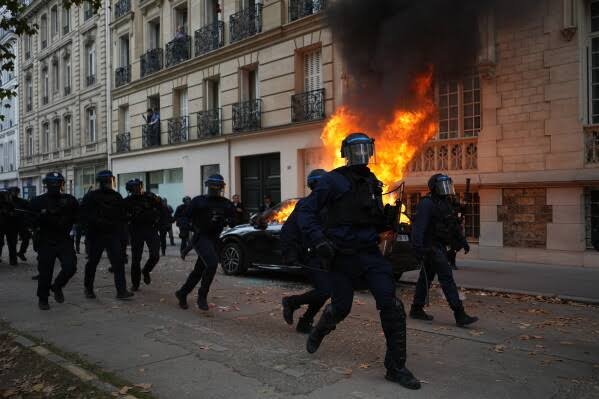
“This is not the face of France! You in the media focus entirely on the violence and destruction during Saturday’s protests. But that is not the majority. It is not ‘us’. That is not France!”
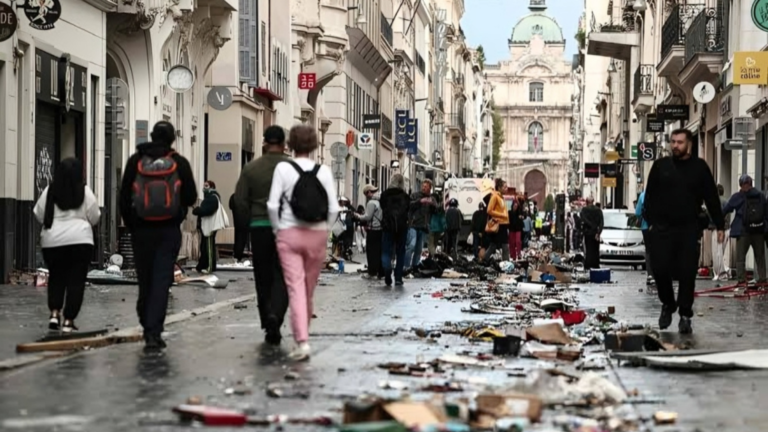
Those were the impassioned words of Elisabeth, who spoke outside a row of smashed shop windows on a tree-lined street in Paris, where shattered glass still littered the pavement. Nearby walls were covered in red graffiti insulting French police, with the date of the riots 17 October scrawled alongside the messages.
Elisabeth was speaking after being asked about the events that unfolded during Saturday’s protests. Visibly distressed, she appeared close to tears as she expressed frustration over the violence and the image it was creating of her country.
Her words reflected a broader concern among some residents that the destruction dominating headlines should not be mistaken for the views of the French public as a whole.
“My friend thinks this is civil war in France, but I don’t,” Elisabeth said. “Saturday is about something else entirely.”
Her comments highlighted the uncertainty surrounding the unrest, raising questions about what actually happened, who was responsible for the violence and what motivated the destruction.
While some of the looting appeared opportunistic, the scale and nature of the violence raised suspicions that at least some incidents may have been planned in advance. The timing also prompted questions, particularly after weeks of student protests had already brought tensions to the surface.
Who was behind the riots? Why did the violence erupt at this particular moment? And who, if anyone, stands to benefit from the destruction?
These questions remain central to understanding the events that shook Paris. While the damage to businesses and public spaces was visible, the motives behind the unrest were less clear.
Even Elisabeth, despite her strong feelings about the violence, was not entirely certain what had driven the events of Saturday.
Her reaction nevertheless captured the frustration of a resident who feared that the actions of those involved in the destruction would come to define an entire nation.
As the debate over the protests continued, the challenge was not simply to assess the damage but also to understand the forces behind the unrest and to distinguish the actions of those responsible for the violence from the wider public.

+ There are no comments
Add yours