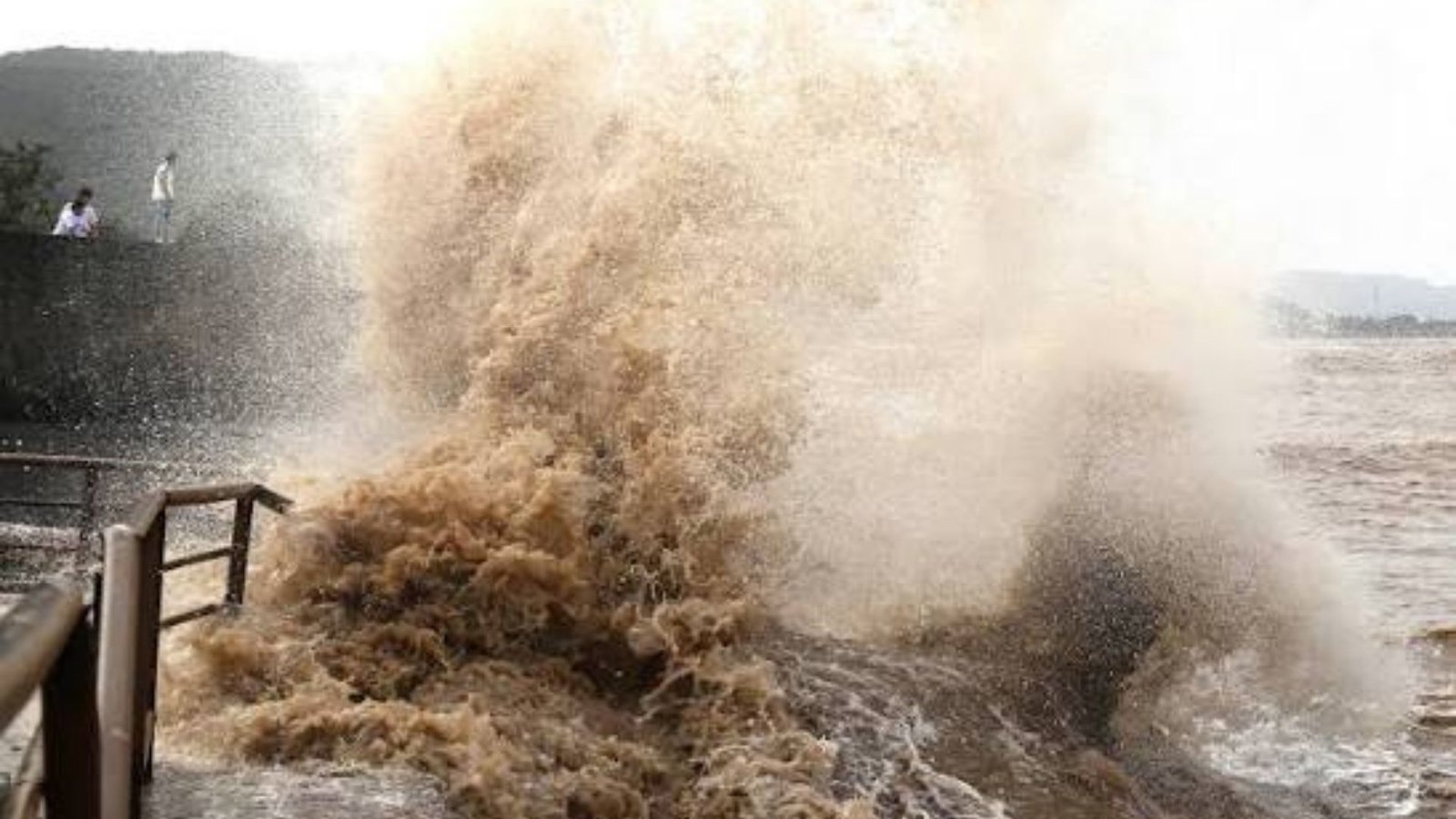
Emergency crews across China’s east coast spent Sunday clearing roads littered with fallen trees after Typhoon Bavi the strongest storm to hit the country this year roared ashore, unleashing flooding, landslides and chaos following the evacuation of nearly two million people.
Bavi weakened to a tropical storm after moving inland, but forecasters warned it would continue dumping prolonged, widespread heavy rain across eastern and northern China. The storm first made landfall in Yuhuan, Zhejiang province, late Saturday night, before striking Yueqing shortly after midnight with winds reaching 144 kph (90 mph).
In Yueqing, more than 1,300 trees were toppled over 700 completely uprooted while floodwaters swallowed streets and triggered landslides in mountainous areas. State media showed massive boulders crashing onto roads and swollen rivers spilling into surrounding vegetation.
Authorities evacuated 1.72 million people in Zhejiang, a major manufacturing and tech hub, along with 130,000 in Fujian and 34,000 in Shanghai’s coastal districts. Schools, public transport, workplaces and outdoor activities were suspended, and more than 400 flights plus dozens of train services were cancelled as officials braced for a worst‑case scenario.
Before striking China, Bavi swept past northern Taiwan, dumping nearly 80 cm (31 inches) of rain in Miaoli County. Taiwan reported 134 injuries, mostly from falls or flying debris, and saw 199 flights cancelled. Over 14,000 people were evacuated and 170,000 households lost power as the storm skirted the island.
Earlier, Bavi battered Japan’s remote southwestern islands, knocking out electricity to thousands of homes and forcing airlines to cancel flights affecting more than 26,000 passengers.
From Japan to Taiwan to China, Bavi’s path has carved a destructive arc across East Asia a stark reminder of the region’s growing vulnerability to extreme weather.









+ There are no comments
Add yours