
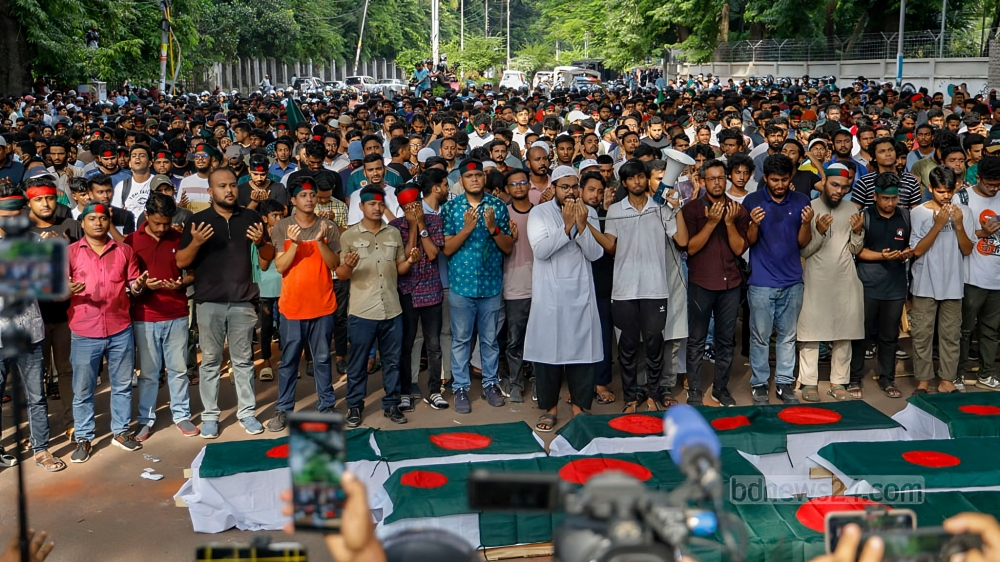
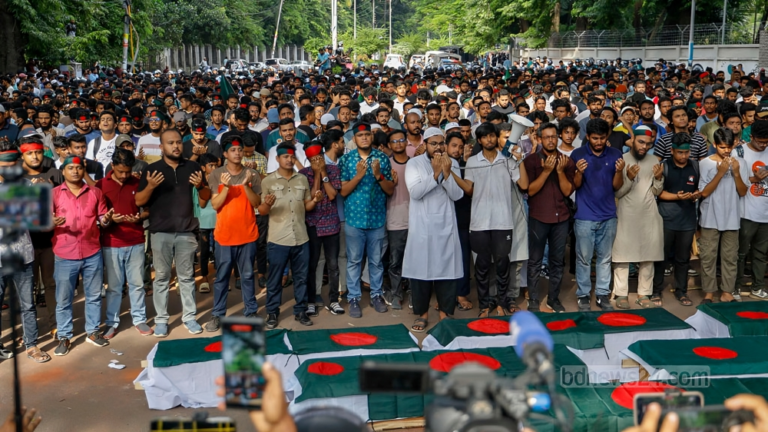
Hundreds of students gathered late Monday night at Dhaka University’s VC Chattar to offer a funeral prayer in absentia, organised under the banner of the Dhaka University Central Students’ Union (DUCSU). The prayer, held at 10:45pm and led by DUCSU Vice President Shadik Kayem, drew a large crowd of students moved by the unfolding crisis in the Middle East.
After the prayer, students marched through several roads on campus before concluding with a brief rally at the base of the Raju Memorial Sculpture. Speaking to the gathering, Kayem said the suffering of Muslims worldwide was rooted in deep divisions within the Muslim world. He urged young people and leaders across Muslim‑majority nations, including Bangladesh, to unite in the face of global injustice.
“We may have ideological differences, but we must stand together against injustice, oppression and imperialism,” he said. “If we remain silent, what is happening in Iran or Palestine today may happen in our own country one day.”
Kayem announced plans to turn Dhaka into what he described as a “solidarity hub” for the Muslim world, expressing hope for the freedom of oppressed Muslim communities in Palestine, Kashmir, Xinjiang and Rakhine.
DUCSU leaders also condemned the recent military actions by the United States and Israel in Iran, presenting a six‑point demand to the international community. Their demands called for:
Immediate diplomatic efforts to halt the violence
Accountability for alleged violations of international law
Protection of civilians under humanitarian law
Transparent investigations into breaches of international standards
Expanded humanitarian assistance for the injured and displaced
Conflict resolution through dialogue and mutual respect rather than force
Earlier in the day, students at Jagannath University held a similar funeral prayer at noon, while another was offered after Asr at the Baitul Mukarram National Mosque.
The prayers followed the killing of Iran’s Supreme Leader Ayatollah Ali Khamenei in a joint US–Israel attack on Saturday night (Bangladesh time). Khamenei, a central figure in Iran’s Islamic Revolution and its supreme leader for decades, remained one of the most influential political and religious figures in the region.





+ There are no comments
Add yours