
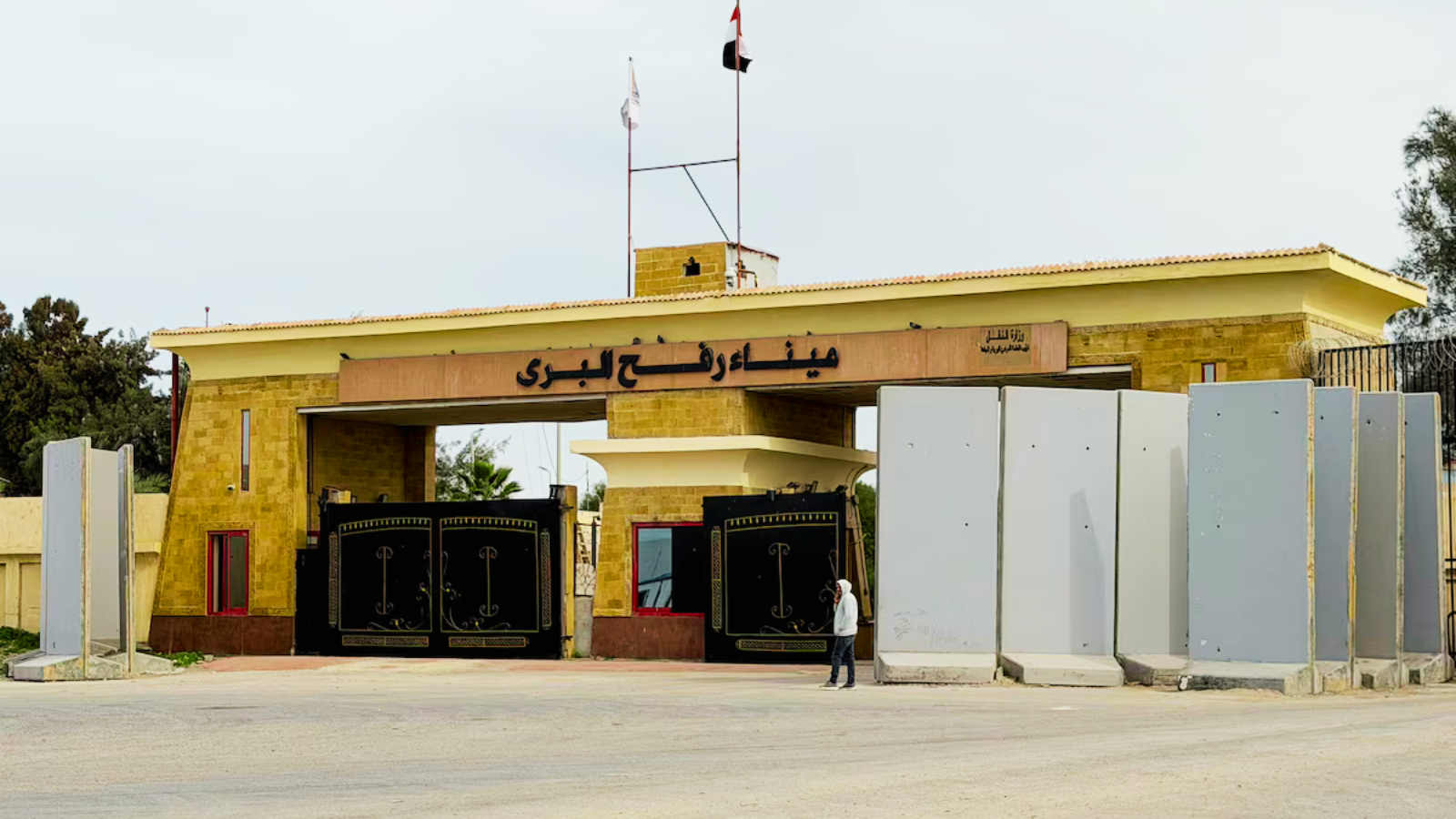
The Rafah border crossing Gaza’s only gateway not directly controlled by Israel is set to partially reopen on Monday, marking a significant shift after more than a year of near‑total closure. Israel’s military coordination body, COGAT, confirmed that a limited number of people will be allowed to travel through the crossing each day under strict security procedures.
Under the pilot phase, up to 150 people will be permitted to leave Gaza daily, while a maximum of 50 will be allowed to enter. Every traveller will undergo extensive security checks, COGAT said. The crossing connects Gaza to Egypt’s Sinai Peninsula and has long served as a vital humanitarian lifeline.
Before the 2023 Hamas-Israel war, Rafah was jointly operated by Palestinian, Egyptian and Israeli authorities. It was the primary route for humanitarian aid into Gaza, with nearly one‑third of the enclave’s population relying directly on supplies entering through this corridor.
Following the Hamas attack on 7 October 2023 and Israel’s subsequent military operation, security at Rafah tightened sharply. By May 2024, the crossing was completely shut. Its reopening was later included in the three‑phase peace plan proposed by U.S. President Donald Trump in September 2025. With both Israel and Hamas agreeing to the plan, a ceasefire took effect on 10 October and is now in its second stage.
Ismail Al‑Dawabda, director of Gaza’s government media office, said that around 80,000 Palestinians fled to Egypt via Rafah during the Israeli offensive and many are now hoping to return home as the situation stabilises.










+ There are no comments
Add yours