
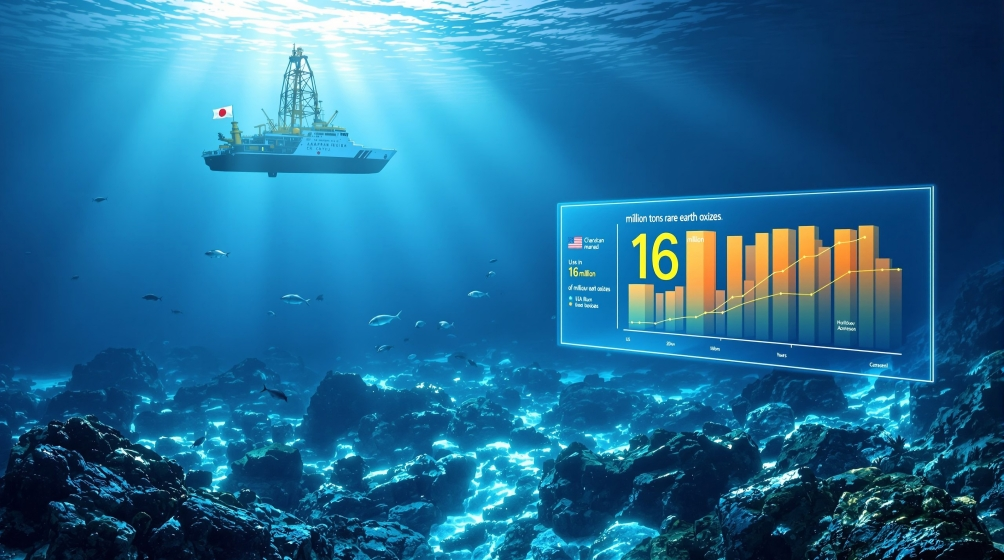
Japan is preparing to carry out a groundbreaking test to extract rare earth rich mud from the deep seabed near Minamitori Island, about 1,900 kilometers southeast of Tokyo. The trial will run from January 11 to February 14 and represents the first continuous attempt anywhere in the world to lift rare earth mud from roughly 6,000 meters below the surface onto a vessel.
The project is part of Japan’s push to secure stable supplies of critical minerals at a time when China, the leading global supplier of rare earths, is tightening export controls. Shoichi Ishii, program director of the Cabinet Office’s national platform for innovative ocean developments, said the mission aims to build a domestic supply chain capable of supporting industries that rely on these minerals.
The government views the initiative as a key component of its broader strategy to strengthen maritime and economic security.
During the January test, engineers will connect the deep sea mining system and verify whether it can lift 350 metric tons of rare earth mud per day. Environmental impacts will be closely monitored both on the seabed and aboard the vessel.
Although no production target has been set, officials say a full scale mining trial could begin in February 2027 if the test succeeds. The government has already invested about 40 billion yen since 2018, though it has not disclosed the size of the reserves.
Ishii also revealed that while the research vessel was conducting surveys within Japan’s exclusive economic zone around Minamitori Island earlier this year, a Chinese naval fleet entered the area on June 7. He described the incident as alarming, saying the team felt a strong sense of crisis because their activities were limited to resource surveys within Japan’s jurisdiction.
China’s foreign ministry responded that its naval operations comply with international law and urged Japan to avoid escalating tensions.











+ There are no comments
Add yours