
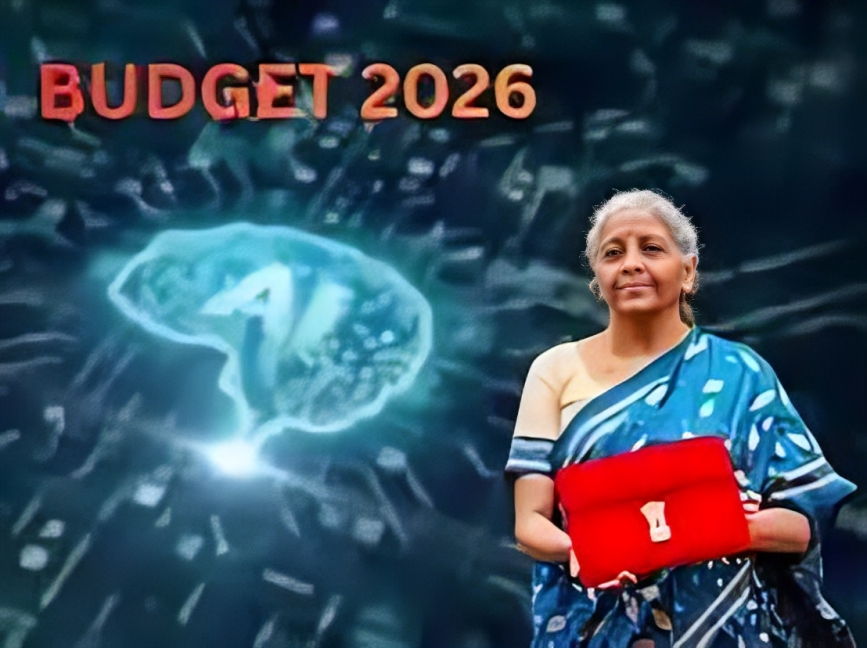
India has unveiled one of its most technology‑driven budgets to date, signaling a bold push to strengthen artificial intelligence, semiconductor manufacturing and digital infrastructure as global tariff battles reshape trade flows.
Finance Minister Nirmala Sitharaman presented the 2026-27 Union Budget on Sunday, framing it as a blueprint to “accelerate and sustain economic growth” amid a turbulent global environment where supply chains are strained and multilateral trade frameworks are under pressure.
A Budget Built for a High‑Tech Future
With total expenditure projected at $583 billion, the budget places heavy emphasis on domestic manufacturing and next‑generation technologies. The government is offering tariff concessions to marine, leather and textile exporters sectors hit hardest by US duties while also removing import taxes on materials essential for rare‑earth processing, lithium‑ion batteries, solar glass and electric‑vehicle components.
India is still without a trade agreement with the US, its largest trading partner, which imposed tariffs of up to 50 percent last year over New Delhi’s purchases of Russian oil. To soften the blow, India has been pursuing alternative partnerships, including a landmark deal with the EU last week that slashes duties on 99.5 percent of Indian exports to the bloc.
Massive Boost for Semiconductors and Cloud Infrastructure
In a major move to strengthen India’s position in the global chip race, the government has doubled semiconductor manufacturing allocations to $4.8 billion. Foreign companies offering cloud services through Indian data centers will also receive a tax holiday until 2047, a long‑term incentive designed to attract global tech giants.
AI for Agriculture: Bharat‑VISTAAR
One of the standout initiatives is Bharat‑VISTAAR, a multilingual AI‑powered platform designed to transform India’s agriculture sector. The system will deliver real‑time, personalized guidance to farmers on crop management, weather patterns, soil health and government schemes—available in multiple Indian languages to ensure broad accessibility.
“Technology Is Central to Viksit Bharat 2047”
Experts say the budget reflects India’s determination to meet its ambitious goal of becoming a fully developed nation by 2047.
“There is a lot of focus on AI and technology… Without technology, it would be difficult to achieve that target,” said Prof. Pardeep S. Chauhan of Jawaharlal Nehru University, referring to the government’s Viksit Bharat 2047 vision.












+ There are no comments
Add yours