
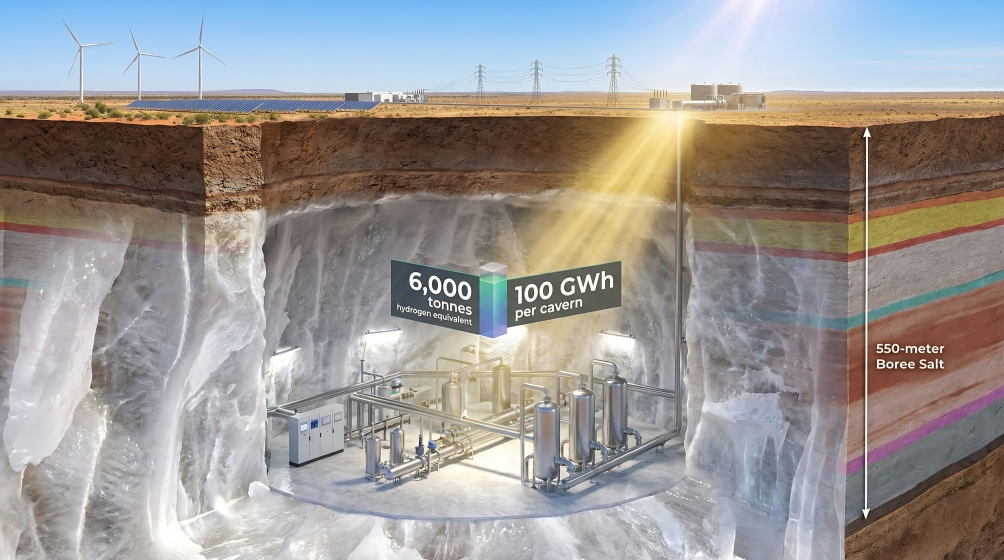
An ancient rock formation hidden deep beneath outback Queensland and older than the dinosaurs is emerging as a surprising contender to solve one of Australia’s biggest renewable‑energy challenges: large‑scale storage.
Geoscience Australia has identified a thick salt deposit in the Adavale Basin as a potential site for an underground hydrogen battery capable of powering millions of homes across eastern Australia. If developed, it could help close the looming storage gap as the nation accelerates its shift toward green energy.
The Adavale Basin lies beneath Quilpie, Blackall and Charleville, and sits below the vast Great Artesian Basin (GAB), the world’s largest underground freshwater reservoir. With a $31 million drilling program now complete, locals were eager to know whether their only reliable water source might be at risk. Geoscience Australia says the Adavale Basin is buried beneath the Eromanga and Galilee Basins far below the GAB and does not appear at the surface, easing concerns about water contamination.
What makes the site remarkable is the Boree Salt deposit, the only known rock‑salt layer in eastern Australia thick enough to store hydrogen deep underground. Mitchell Bouma, Geoscience Australia’s head of advice, investment, attraction and analysis, said the salt formation could be engineered into vast, artificial battery‑like caverns capable of holding renewable energy at scale.
If the project proceeds, it could become one of the most significant energy‑storage developments in the country and a crucial piece of Australia’s clean‑energy future.






+ There are no comments
Add yours