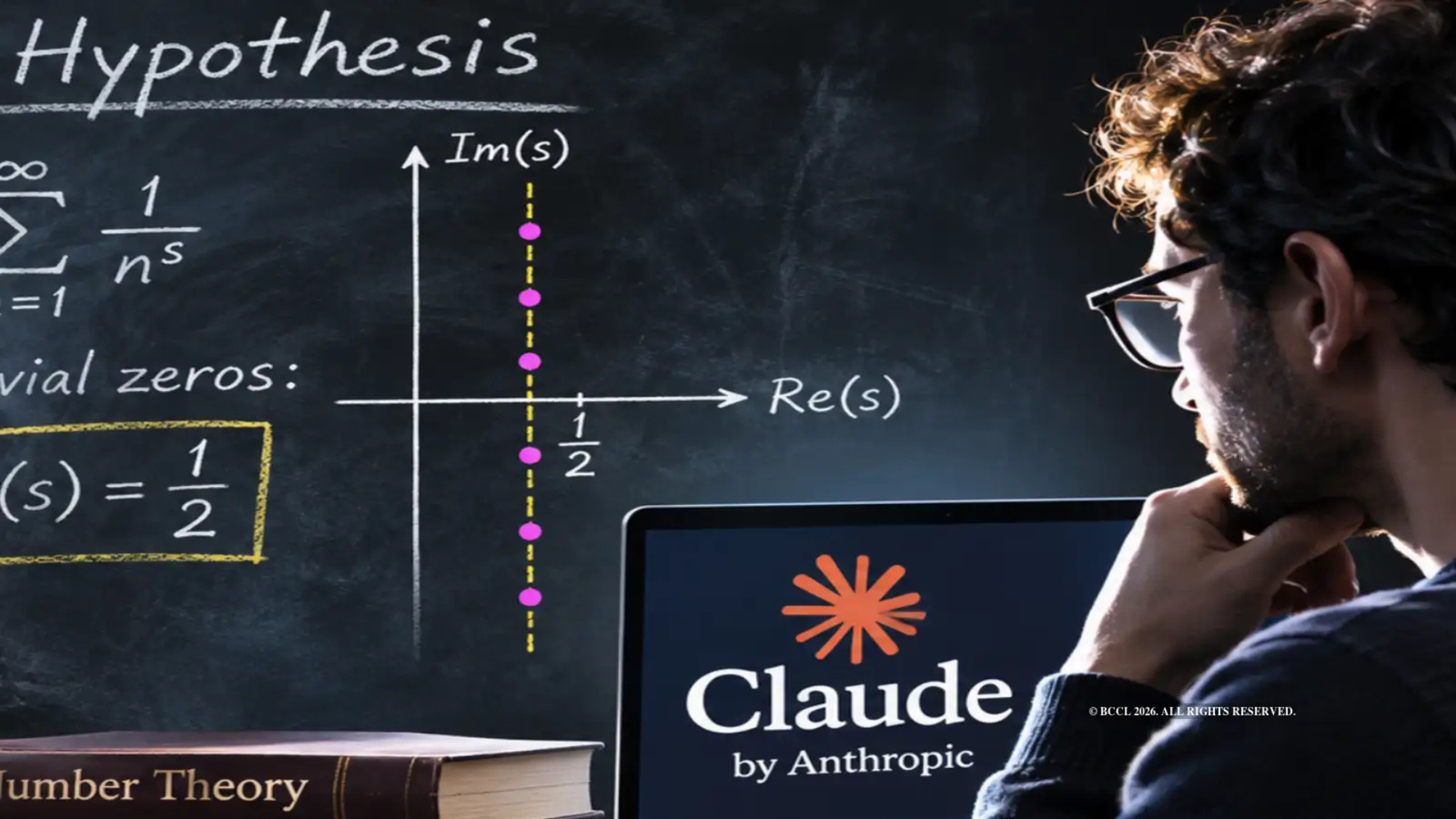
A mathematician at artificial intelligence company Anthropic has sparked global excitement after claiming he used the firm’s AI chatbot, Claude, to help solve the legendary Riemann Hypothesis, one of the most famous and challenging unsolved problems in mathematics.
Levent Alpöge, an Anthropic employee and mathematician, announced that he spent approximately six weeks working with a non-public version of Claude to develop what he describes as a complete proof of the nearly 170-year-old mathematical puzzle. The announcement came just a day after Anthropic made its debut on the U.S. stock market, drawing significant attention from both the scientific and technology communities.
If the proof is ultimately validated by independent experts, it would rank among the most important mathematical discoveries in history. Alpöge described the achievement as “one dawn across science of something far greater,” suggesting it could mark a turning point in the use of artificial intelligence for advanced scientific research.
The Riemann Hypothesis, proposed by German mathematician Bernhard Riemann in 1859, concerns the distribution of prime numbers along the number line. Prime numbers are considered the building blocks of mathematics and play a crucial role in number theory, cryptography and modern computing.
Because of its complexity and far-reaching implications, the hypothesis has long been regarded as the most famous unsolved problem in mathematics. Solving it could unlock major advances across several scientific and technological fields.
Alpöge said the timing of the announcement was unfortunate, as it coincided with Anthropic’s highly publicized stock market debut. He rejected suggestions that the disclosure was intended to capitalize on the company’s market momentum.
“The precise timing is horrible,” Alpöge said, adding that he wished he had completed the work earlier. He insisted there was no connection between the announcement and Anthropic’s public listing.
One of the most astonishing aspects of the claim is the scale of the proof itself. According to Alpöge, the complete proof, written in Lean, a computer language used to formally verify mathematical proofs, exceeds 250,000 pages. The use of Lean allows mathematical arguments to be checked with a high level of precision by computers.
Despite the excitement generated by the announcement, experts have urged caution until the proof undergoes a rigorous review process. Renowned mathematician Terrance Tao said verification of the work is likely to take considerable time due to its complexity and size.
“I imagine the digestion process will take some time, though in this case at least we have a human author to communicate with to assist with this task,” Tao said.
The claim comes amid rapid advances in artificial intelligence, with leading AI developers increasingly reporting breakthroughs on difficult scientific and mathematical challenges that have resisted human solutions for decades. If confirmed, the Riemann Hypothesis proof could become one of the clearest demonstrations yet of AI’s potential to accelerate human knowledge and reshape the future of research.
For now, however, the mathematical world awaits the painstaking process of peer review and verification before declaring whether one of its greatest mysteries has finally been solved.








+ There are no comments
Add yours