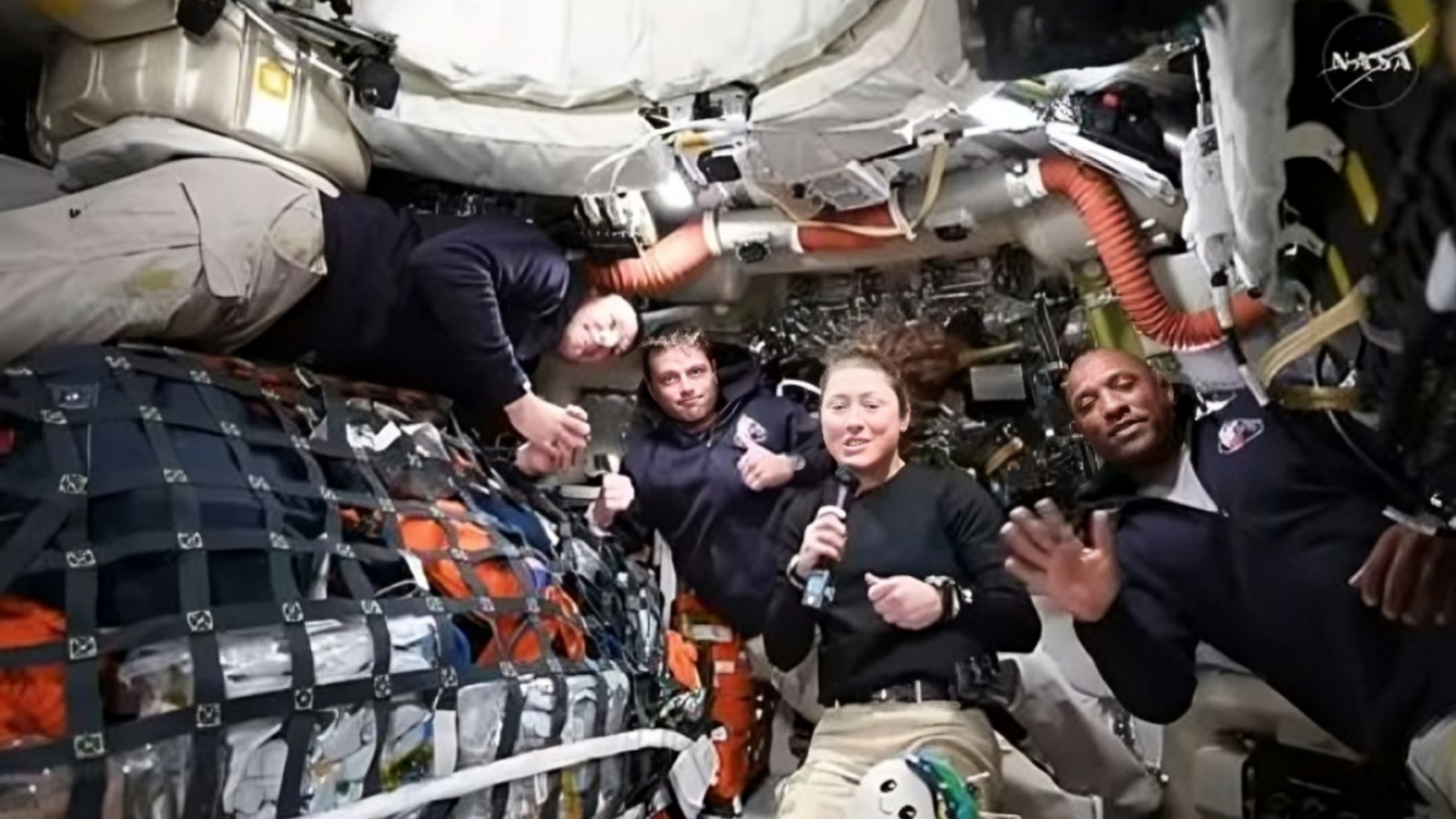
NASA’s Artemis 2 astronauts are closing in on one of the mission’s most significant milestones as they prepare to enter the Moon’s “sphere of influence,” where lunar gravity overtakes Earth’s pull. On day five of their 10‑day journey, the Orion spacecraft was travelling roughly 215,000 miles from Earth and 65,000 miles from the Moon, offering the crew extraordinary views of the lunar surface.
The astronauts awoke to a special message from Apollo 16 legend Charlie Duke, who walked on the Moon in 1972. “Below you on the Moon is a photo of my family. I pray it reminds you that we in America and all of the world are cheering you on,” the 90‑year‑old said, praising the team for carrying the Apollo legacy into a new era.
Earlier on Sunday, NASA released a striking image taken by the crew showing the distant Moon with the Orientale basin clearly visible. While orbiters have photographed the massive bullseye‑shaped crater before, this marks the first time humans have seen the entire basin with their own eyes, a milestone NASA highlighted with pride.
The spacecraft is expected to enter the Moon’s gravitational zone overnight, setting the stage for the first crewed lunar flyby in more than 50 years. NASA officials say the operations and science teams are fully prepared for the historic moment, which will allow the astronauts to observe the Moon directly and capture new imagery during several hours of close approach.
Mission scientists note that part of the excitement lies in the unknown, as the crew may witness features never documented from a human perspective. If all goes smoothly, astronauts Christina Koch, Reid Wiseman, Victor Glover and Canadian Jeremy Hansen could travel farther from Earth than any humans in history as Orion swings around the Moon.
NASA says the crew has already completed a manual piloting demonstration and reviewed their flyby procedures, including the lunar features they will study and photograph. Engineers are closely monitoring Orion’s life‑support ecosystem, emphasising the importance of gathering data from the spacecraft’s first crewed flight. The astronauts also tested their survival suits as part of ongoing system checks.
With the Moon’s gravity now within reach, Artemis 2 is entering its most dramatic and scientifically rich phase a moment NASA hopes will pave the way for humanity’s return to the lunar surface.









+ There are no comments
Add yours