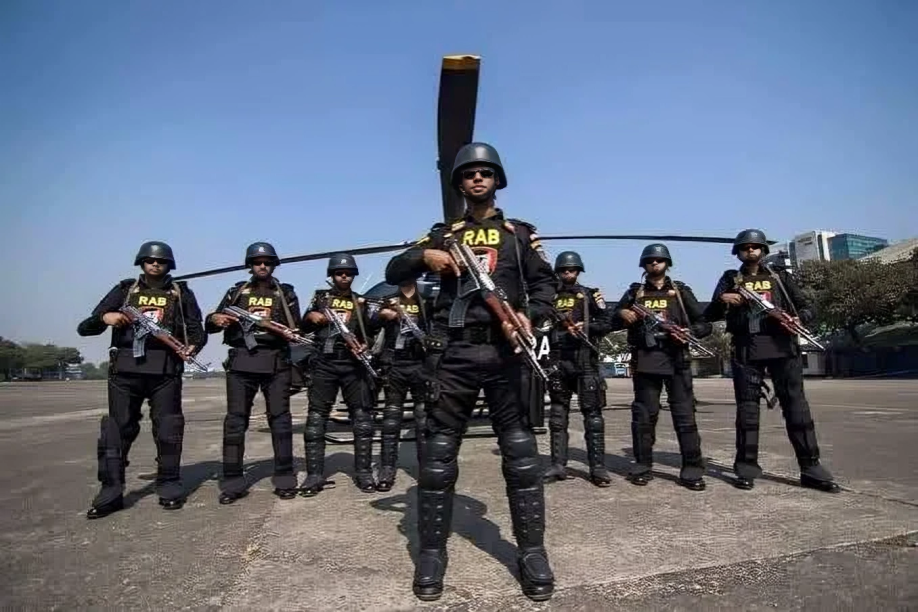
The Commission of Inquiry on Enforced Disappearances has issued a sweeping set of recommendations aimed at ending enforced disappearances and restoring accountability in Bangladesh including the abolition of the Rapid Action Battalion (RAB), the withdrawal of armed forces personnel from all civilian administrative roles, and the repeal or major reform of several security laws.
The commission’s final report, submitted to Chief Adviser Prof Muhammad Yunus on Sunday and made public in Dhaka on Monday, was presented by Chairman Justice Moyeenul Islam Chowdhury.
Major Legal and Institutional Reforms Proposed
The report calls for:
Repeal or major amendment of the Anti‑Terrorism Act 2009
Repeal of Section 13 of the Armed Police Battalions (Amendment) Act 2003
Conversion of secret detention facilities known as “aynaghors” into museums to preserve truth, memory, and accountability
Justice Moyeenul said the recommendations were designed to put a “definitive end” to enforced disappearances and serious human rights violations.
Accountability and Counterterrorism Reforms
The commission urged:
A society‑based approach to counterterrorism
Strong accountability mechanisms for all security forces
Mandatory human rights training
Victim‑centred justice
Comprehensive compensation and rehabilitation for victims and families
Military Officers in Civilian Agencies Undermine Accountability
Justice Moyeenul said that when armed forces officers are deputed to civilian agencies, they fall outside their own chain of command, making punitive action difficult.
He clarified that the Army, Navy, and Air Force as institutions were not directly involved in enforced disappearances, but many implicated officers were serving on deputation with RAB, NSI, and DGFI.
“It is not the work of members of the Armed Forces to capture thieves or robbers,” he said. “They should remain in cantonments and focus on training and preparation for war.”
He added that maintaining law and order is the responsibility of the police, and an elite force could be formed within the police if needed.
Patterns of Enforced Disappearances
The commission found:
1,913 complaints received
1,569 taken up for active consideration
251 individuals still missing
36 bodies recovered
Testimony taken from 222 suspects and statements from 765 victims
RAB was implicated in 25% of cases, police stations in 23%, with the rest involving the Detective Branch, CTTC, DGFI, and NSI.
Most victims were political opponents of the former regime. Disappearances spiked six months to one year before national elections in 2013, 2017, 2022, and 2023.
Justice Moyeenul said the pattern amounted to an assault on democracy.
Dumping Sites and Secret Detention Centres
Commission member Nur Khan Liton detailed alleged dumping sites:
Baleshwar River, Barguna
Padma River, Munshiganj
Rupsha River, Khulna
Jurain graveyard, Dhaka
The commission recommended exhumation and DNA testing to identify victims.
Another member, Sazzad Hossain, said investigators identified 40 detention centres, including 22-23 operated by RAB, with others run by DGFI, NSI, CTTC, and the Detective Branch. RAB allegedly destroyed the most evidence.
Mixed Reactions to the Recommendations
Criminologist Dr Omar Faruk opposed outright abolition of institutions, arguing that reforms not dismantling were the solution.
Supreme Court lawyer Manzil Murshid questioned whether the commission had the mandate to recommend abolishing forces or repealing laws, saying such decisions should be left to elected lawmakers once parliament is formed.









+ There are no comments
Add yours